Key takeaways
- Format: Two-part price comparison, short-term vs lasting value, 9:16.
- Best for: Insurance-covered therapy platforms and any service seen as "too expensive".
- Hook: "These days $10 will get you…" invites the reader to fill in a familiar price.
- Reuse it: List three or four cheap everyday purchases, then reveal your product costs the same but lasts longer.
Available sizes
What is a comparison ad?
A comparison ad sets the product against an alternative, such as a competitor, the old way of doing things or a cheaper option, usually in a two-column layout or table. It helps buyers who are already weighing options see quickly why this one is the better choice.
See all comparison ads →Why this comparison ad works
- 01
Price anchoring with everyday items
Coffee, beer and a movie ticket set a mental reference price people already accept. Therapy at the same price then feels small.
- 02
Short-term vs lasting value
The two labels frame the decision as a smarter use of $10, not a new expense. It turns a cost into an investment.
- 03
Humour lowers resistance
"One hand manicured (maybe)" adds a wink that keeps a mental health ad light and shareable without making fun of the topic.
- 04
Busts a common myth
Many people assume therapy costs $150+ a session. Stating the average copay corrects that belief in one line.
Full creative breakdown
Who this ad targets
US adults aged about 25–45 with employer or marketplace health insurance who have considered therapy but assume it's too expensive. They are price-aware, spend small amounts on coffee and nights out without thinking, and respond to practical value arguments. The ad also reaches people who don't realise their plan covers mental health care. It suits a consideration-stage audience that already knows therapy can help but needs a reason to act now.
Copywriting analysis
The headline "These days $10 will get you" is a conversational setup that taps into shared frustration about rising prices. The list items are concrete and slightly funny; "(maybe)" after the manicure and "at the microbrewery" add specific detail that feels true to life. The labels "SHORT-TERM VALUE" and "LASTING VALUE" do the persuasive work, reframing the choice. The payoff line stresses "your own caring licensed therapist", which answers quality concerns as well as price, and the parenthesis "(average insurance copay is only $10)" adds a factual-sounding proof point. Using "average" keeps the claim defensible. Bolding the parenthesis makes the price the last thing the eye reads.
Visual design
The ad is split into horizontal bands: pale cream for the short-term list and a stronger lime-yellow for the lasting-value payoff, so the colour shift marks the turn in the argument. Rounded pill labels look like UI tags and make the sections easy to scan. A small food photo adds realism to the list. The serif headline feels warm and editorial, while body text uses a clean sans-serif. The bottom lifestyle photo matches the lime palette and shows a relaxed result.
How to adapt this template for your brand
- Find your product's real price point and the most common price objection.
- List three or four familiar purchases at that price that feel fleeting or indulgent.
- Label the two groups with contrasting values (short-term vs lasting, fun vs life-changing).
- Reveal your product in the second section with a factual, defensible price claim.
- End with an image of the calm or happy outcome, not the product itself.
Tips for therapy platforms ads on Meta
Built for Meta Stories, but the stacked layout also works as a 4:5 Feed crop if you trim the photo. Price claims about health services get extra scrutiny, so keep the "average" qualifier and link to a page that explains copays. Avoid targeting by health conditions; target by life stage or interests such as personal finance or self-improvement. A/B test the list items for your audience, for example gym day pass or takeout lunch, since relevance drives the anchor effect.
About this creative
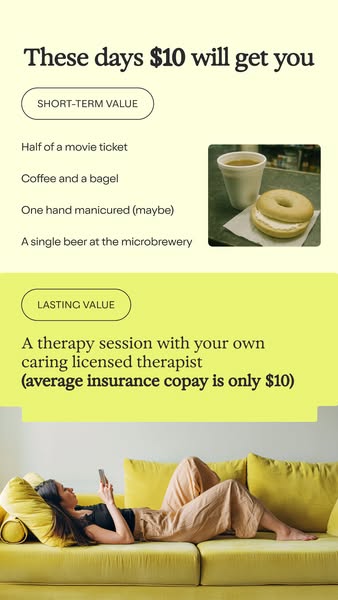
This 9:16 comparison ad tackles the cost objection head-on. The top section sits on a pale cream-yellow background with the bold serif headline "These days $10 will get you". A pill-shaped outline label reads "SHORT-TERM VALUE", followed by a list of small everyday purchases: half of a movie ticket, coffee and a bagel, one hand manicured (maybe), and a single beer at the microbrewery. A photo of a paper coffee cup and a bagel on a deli tray sits beside the list. The middle section switches to a brighter lime-yellow block with a second label, "LASTING VALUE", and the payoff: "A therapy session with your own caring licensed therapist (average insurance copay is only $10)". The bottom of the frame shows a woman lying relaxed on a lime-green sofa, looking at her phone, which shows the calm result of the purchase. The layout reads top to bottom like a receipt of choices.
Meta ad · 338 × 600 · Therapy Platforms
Therapy Ad: "These Days $10 Will Get You" Comparison
This vertical comparison ad from an online therapy platform (likely Grow Therapy) lists everyday things $10 buys, then reveals that a therapy session costs about the same with insurance. It is a strong template for any subscription or service brand fighting the "too expensive" objection.
Added
All brand names and logos are property of their owners. Adplaylist is not affiliated with or endorsed by these brands.
Details
Ad copy
Primary text
Most people pay about $10 per therapy session with insurance. Find an in-network therapist who fits you and book your first session this week.
Description
Find an in-network therapist in minutes.
On-image text
These days $10 will get you | SHORT-TERM VALUE | Half of a movie ticket | Coffee and a bagel | One hand manicured (maybe) | A single beer at the microbrewery | LASTING VALUE | A therapy session with your own caring licensed therapist (average insurance copay is only $10)
Headline ideas for this template
- 1Your therapy session costs less than lunch.
- 2Skip one beer. Book one session.
- 3$10 for coffee, or $10 for you?
- 4Therapy is probably cheaper than you think.
- 5Your insurance likely covers therapy. Use it.
Meta image ad specs
| Placement | Ratio | Size (px) |
|---|---|---|
| Feed | 1:1 or 4:5 | 1080×1080 / 1080×1350 |
| Marketplace | 1:1 | 1200×1200 |
| Messenger inbox | 1:1 | 1200×1200 |
| Stories & Reels | 9:16 | 1080×1920 |
This template is 1:1. Request 4:5 or 9:16 to cover all placements.