Key takeaways
- Format: Price comparison ad where the headline names the old price and the visual shows the new one.
- Best for: Challenger brands undercutting an expensive, well-known category price.
- Hook: A question that voices the buyer's frustration, then sides with them.
- Reuse it: Name the competitor price in text and reveal your price only in the visual.
Available sizes
What is a comparison ad?
A comparison ad sets the product against an alternative, such as a competitor, the old way of doing things or a cheaper option, usually in a two-column layout or table. It helps buyers who are already weighing options see quickly why this one is the better choice.
See all comparison ads →Why this comparison ad works
- 01
Anchor before the answer
Mentioning $50+ first makes $13 feel dramatically cheaper. The contrast does the selling without a discount badge.
- 02
Empathy builds trust
We do too puts Roofr on the roofer's side. It feels like a peer complaining, not a vendor pitching.
- 03
The visual completes the sentence
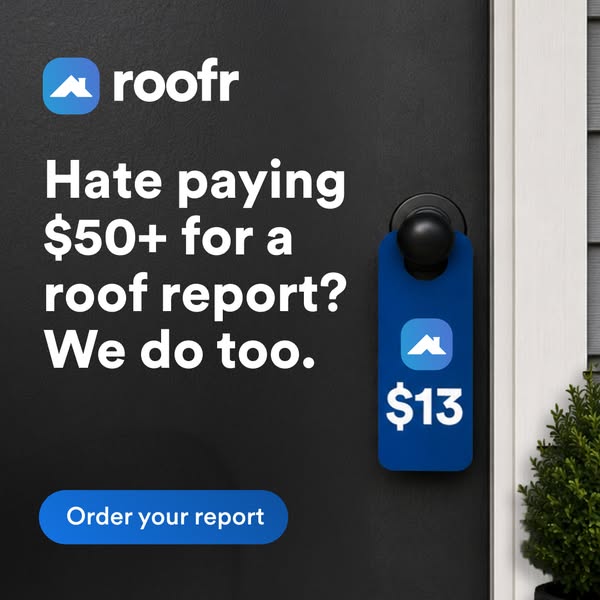
The headline never states Roofr's price. Viewers find $13 on the hanger themselves, which makes the message stick.
- 04
No competitor named
Using a price range instead of a brand avoids legal risk. Every roofer still knows exactly who is being referenced.
Full creative breakdown
Who this ad targets
The ad targets US roofing contractors who currently buy measurement reports from established providers at $50 or more each. They are aware of the category, likely have an existing supplier, and feel the cost most on unconverted leads. The empathetic tone suits owner-operators and small teams who manage their own spend and are open to switching if the savings are clear and the quality is comparable.
Copywriting analysis
The headline opens with a question that names a pain and a number: Hate paying $50+ for a roof report? Hate is strong, informal language that matches how contractors talk about overheads. The plus sign suggests many readers pay even more. The reply, We do too, is only four words, conversational and slightly cheeky, and it creates an us-versus-them frame against incumbents without naming one. Crucially, the copy never states Roofr's price; the visual provides it, inviting the eye to finish the story. The CTA Order your report keeps the next step concrete. Compared with the flat-price version, this copy leans on emotion and comparison rather than a guarantee.
Visual design
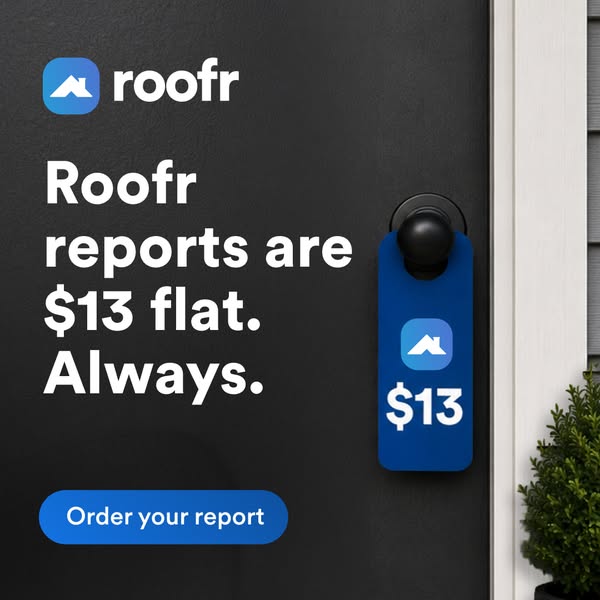
The design reuses the black door scene, with white type on the left and a blue door hanger on the right. Brand blue appears only on the logo, hanger and CTA button, which forms a clean visual path to the price and the action. The heavy, rounded headline stays legible on small screens. Generous dark space around the copy keeps the frame calm. Because the layout matches the flat-price variant, any performance difference can be attributed to the copy.
How to adapt this template for your brand
- Find the price your audience is used to paying for the category.
- Write a question headline that names that price and the frustration around it.
- Add a short, empathetic reply that sides with the buyer.
- Show your lower price on a relevant prop instead of in the headline.
- Run it against a plain price-statement version with the same visual to test copy.
Tips for saas ads on Meta
On Meta, run this alongside the $13 flat-price creative in the same ad set so the algorithm can pick the stronger hook. Keep everything except the headline identical to isolate copy performance. Avoid naming competitors in the ad or primary text to stay within platform and comparative advertising rules. Target contractors with interests in roofing suppliers and existing measurement tools, and use a conversion objective tied to first report orders to measure the switching effect.
About this creative
This square Roofr ad is a price-anchor variant of the brand's door-hanger concept. The setting is a matte black front door with a black knob, a white door frame and a small green shrub in the bottom right. A blue door hanger with the Roofr app icon and a large white $13 hangs from the knob. The Roofr logo sits top left, followed by a white headline in a heavy sans-serif: Hate paying $50+ for a roof report? We do too. A blue pill button at the bottom reads Order your report. The question names a familiar frustration and the competitor price, while the answer is shown rather than written, because the hanger quietly displays $13. We do too positions Roofr as being on the roofer's side against expensive incumbents. The design is identical to the flat-price version, making the pair ideal for an A/B test of empathy-led versus statement-led copy.
Meta ad · 338 × 600 · SaaS
Roofr Price Comparison Ad: Hate Paying $50+ for a Roof Report?
This Roofr ad compares its $13 roof measurement reports against the $50+ roofers typically pay elsewhere. It pairs an empathetic question headline with a branded door hanger showing the lower price. It is a useful comparison template for challenger brands that undercut an established, more expensive category standard.
Added
All brand names and logos are property of their owners. Adplaylist is not affiliated with or endorsed by these brands.
Details
Ad copy
Primary text
Paying $50 or more for every roof report adds up fast, especially on leads that never sign. Roofr measurement reports are $13 flat, every time. Same accurate measurements, a fraction of the cost.
Description
Flat-price roof measurement reports for roofers.
On-image text
roofr | Hate paying $50+ for a roof report? We do too. | $13 (door hanger) | Order your report
Headline ideas for this template
- 1Why pay $50 when $13 does the job?
- 2Your roof reports are overpriced.
- 3Cut your roof report bill by 70%+.
- 4Same measurements. A quarter of the price.
- 5Tired of $50 roof reports? Switch.
Meta image ad specs
| Placement | Ratio | Size (px) |
|---|---|---|
| Feed | 1:1 or 4:5 | 1080×1080 / 1080×1350 |
| Marketplace | 1:1 | 1200×1200 |
| Messenger inbox | 1:1 | 1200×1200 |
| Stories & Reels | 9:16 | 1080×1920 |
This template is 1:1. Request 4:5 or 9:16 to cover all placements.