Key takeaways
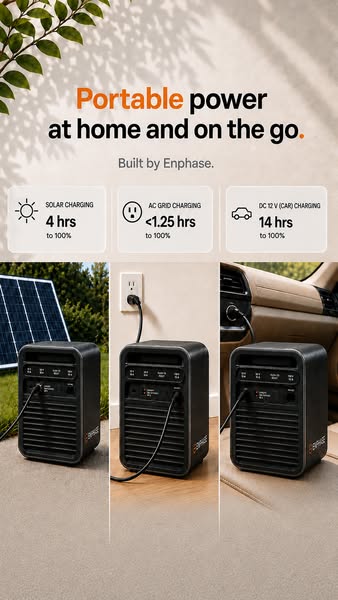
- Format: Three-panel comparison pairing spec cards with matching photos.
- Best for: Products with multiple ways to use, power or charge them.
- Hook: One battery, three ways to recharge, each with a clear time.
- Reuse it: Split the frame into three use cases and put a spec card above each.
Available sizes
What is a comparison ad?
A comparison ad sets the product against an alternative, such as a competitor, the old way of doing things or a cheaper option, usually in a two-column layout or table. It helps buyers who are already weighing options see quickly why this one is the better choice.
See all comparison ads →Why this comparison ad works
- 01
Instantly scannable specs
Big numbers in tidy cards let viewers grasp charging options in seconds, without reading a spec sheet.
- 02
Spec-to-photo alignment
Each card sits directly above its matching photo, so viewers immediately connect the method to a real-life situation.
- 03
Shows versatility
Solar, home and car scenarios prove the product fits many lifestyles, broadening appeal beyond campers.
- 04
Consistent product angle
Using the same product view in all three panels makes the only variable the charging source, keeping the message clear.
Full creative breakdown
Who this ad targets
The ad targets practical, research-minded buyers aged 28–60 comparing portable power stations on specs. They include solar owners wanting a portable add-on, road-trippers and campers who charge from the car, and households preparing for outages who will mostly recharge from the wall. These buyers want proof of flexibility and fast charging before purchase, making the ad suitable for consideration and retargeting audiences.
Copywriting analysis
The headline 'Portable power at home and on the go' covers both main use cases in one line, with 'Portable' highlighted in orange to lead with the core category. 'Built by Enphase' again acts as a trust signal. The spec cards use a consistent structure – method, big number, 'to 100%' – making them easy to compare. Leading with the fast AC time (under 1.25 hrs) in the middle draws attention to the strongest number, while honestly showing the slower 14-hour car charge builds credibility. Uppercase labels and large figures create clear hierarchy. The copy is factual and benefit-light, relying on the numbers and photos to imply convenience, which suits buyers already considering a power station.
Visual design
The design is bright and airy, using a beige wall, natural leaf shadows and white cards with soft shadows for a calm, premium look. Orange is used sparingly on one word and the full stop. The layout follows a strict grid: headline, three cards, then three equal photo panels, creating vertical alignment between spec and scene. The dark product repeats across panels, contrasting with varied backgrounds: sunny patio, interior floor and car interior.
How to adapt this template for your brand
- Pick three ways customers use, power or charge your product.
- Shoot the product from the same angle in each of the three settings.
- Split the lower half into three equal vertical photo panels.
- Add a matching card above each panel with an icon, label and big number.
- Write a headline covering all use cases and highlight one key word in your accent colour.
Tips for solar energy ads on Meta
Use this 9:16 comparison in Meta Stories and Reels and keep the cards in the upper half, clear of UI overlays. It works well for retargeting people who saw lifestyle ads, and for audiences interested in solar, camping, road trips and emergency preparedness. Consider a carousel version with one charging method per card, and test a 4:5 crop for Feed placements.
About this creative
This vertical creative uses a clean, light layout with a soft beige wall, leafy shadows and a branch in the top-left corner. The headline reads 'Portable power at home and on the go.' with 'Portable' highlighted in Enphase orange, followed by the smaller line 'Built by Enphase.' Below, three white rounded cards with simple line icons list charging specs: Solar charging – 4 hrs to 100%; AC grid charging – under 1.25 hrs to 100%; DC 12 V (car) charging – 14 hrs to 100%. The bottom half is split into three vertical photo panels that match the cards above. The left shows the dark grey power station on a patio plugged into solar panels in the sun; the middle shows it on a wooden floor plugged into a wall outlet; the right shows it on a car seat connected to the vehicle's socket. Repeating the same product angle makes the comparison instantly clear.
Meta ad · 338 × 600 · Solar Energy
Portable Power Station Ad Template: Three Charging Methods Compared
This Enphase Energy ad compares three ways to recharge a portable power station – solar, AC wall outlet and 12 V car socket – with charging times above three matching product photos. The vertical 9:16 comparison format suits Stories and Reels and is a strong template for showing versatility and specs in one scannable layout.
Added
All brand names and logos are property of their owners. Adplaylist is not affiliated with or endorsed by these brands.
Details
Ad copy
Primary text
Three ways to recharge, one battery. Top up your Enphase portable power station from solar panels in about 4 hours, from a wall outlet in under 1.25 hours, or from your car's 12 V socket on the road. Power at home and on the go.
Description
Solar, AC wall or car charging
On-image text
Portable power at home and on the go. Built by Enphase. SOLAR CHARGING 4 hrs to 100%. AC GRID CHARGING <1.25 hrs to 100%. DC 12 V (CAR) CHARGING 14 hrs to 100%.
Headline ideas for this template
- 1Three ways to charge, zero ways to run out
- 2Sun, socket or car – you choose
- 3From full to flat to full again, anywhere
- 4Recharge under 1.25 hours at home
- 5One battery for home, road and sun
Meta image ad specs
| Placement | Ratio | Size (px) |
|---|---|---|
| Feed | 1:1 or 4:5 | 1080×1080 / 1080×1350 |
| Marketplace | 1:1 | 1200×1200 |
| Messenger inbox | 1:1 | 1200×1200 |
| Stories & Reels | 9:16 | 1080×1920 |
This template is 1:1. Request 4:5 or 9:16 to cover all placements.