Key takeaways
- Format: Text-only testimonial, square
- Best for: Meditation, sleep and mental wellness app installs
- Hook: "Spotify, but for anxiety" – a familiar-brand analogy
- Reuse it: Swap in your app and a real user story; keep the analogy headline and free CTA
Available sizes
What is a testimonial ad?
A testimonial ad uses a real customer's words, such as a review, quote or comment, as the main message. It answers a buyer's doubts with social proof rather than brand claims, and works especially well when the testimonial is specific about who the customer is and what changed for them.
See all testimonial ads →Why this testimonial ad works
- 01
Instant analogy
Comparing the app to Spotify explains the product in four words: an on-demand library you press play on, but for calming your mind.
- 02
Relatable pain first
The story opens with racing thoughts and replayed conversations, so overthinkers recognise themselves before any product is mentioned.
- 03
Objection handled
"Sitting in silence felt impossible" names the biggest meditation objection, then reframes meditation as giving the brain room rather than switching it off.
- 04
Low-risk close
"Might as well try it. It's free." plus Apple's App of the Day award in the headline make installing feel safe and credible.
Full creative breakdown
Who this ad targets
The ad targets adults in the US who struggle with anxiety, racing thoughts and overthinking but have never stuck with meditation, often because they believe their mind is too busy to sit in silence. They are likely smartphone-first, already use subscription apps like Spotify, and look for quick, practical ways to manage stress. The free offer also speaks to people who are curious but unwilling to pay before trying.
Copywriting analysis
The headline borrows the authority and familiarity of Spotify to position Balance as easy, on-demand and personal. The body is written in the first person, like a friend's confession, which lowers ad resistance. It follows a clear before-after-bridge: a brain that never stops, the discovery that meditation is about giving it room, and the new habit of resetting in a few minutes. Short, conversational sentences and a time promise ("only takes a few minutes") reduce effort, while the closing line "Might as well try it. It's free." removes the last barrier with a casual, no-pressure tone.
Visual design
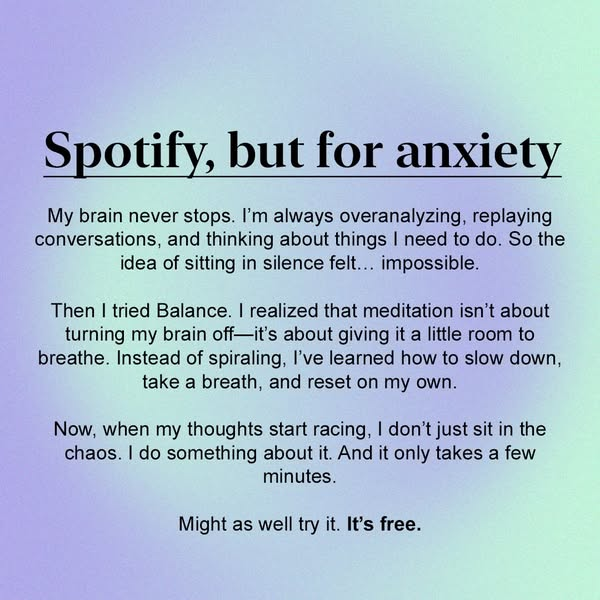
The creative is almost entirely typographic: a large serif headline above centred body copy on a soft lavender-to-blue gradient. The calm colours match the emotional promise of the product, and the lack of imagery makes it look like a native post or note rather than an ad. Generous line spacing keeps a long text readable on mobile, and the bold "It's free" at the end draws the eye to the offer.
How to adapt this template for your brand
- Pick a well-known brand analogy that explains your product in a few words.
- Collect a real customer story that starts with a specific, relatable pain.
- Name the main objection and reframe it in the customer's own words.
- End with a low-risk line such as a free trial or free download.
- Set it on a calm, on-brand gradient with a bold serif headline.
Tips for meditation ads on Meta
Use the square format in Facebook and Instagram feeds, where text-heavy testimonials are read like posts. Pair it with an app-install objective and the "Install now" button. Test the headline as a short overlay in Stories with the story moved into the caption. Rotate several user stories with the same layout to fight ad fatigue, and keep the award line in the headline for social proof.
About this creative
Square text-only testimonial on a soft lavender-to-blue gradient. A bold serif headline "Spotify, but for anxiety" sits above a first-person story about an overthinking mind finding calm with Balance, ending with "Might as well try it. It's free."
Meta ad · 338 × 600 · Meditation
Balance Meditation App Ad: "Spotify, but for anxiety"
This live Meta ad from Balance: Meditation & Sleep promotes its free meditation app with a square, text-only testimonial. An analogy headline hooks anxious overthinkers, and a short first-person story turns meditation from "impossible" into a few-minute habit. A clean template for app installs in the wellness space.
Added
All brand names and logos are property of their owners. Adplaylist is not affiliated with or endorsed by these brands.
Details
Ad copy
Primary text
You deserve more 💙. Prioritize your well-being with Balance, Apple's App of the Day.
On-image text
Spotify, but for anxiety My brain never stops. I'm always overanalyzing, replaying conversations, and thinking about things I need to do. So the idea of sitting in silence felt… impossible. Then I tried Balance. I realized that meditation isn't about turning my brain off—it's about giving it a little room to breathe. Instead of spiraling, I've learned how to slow down, take a breath, and reset on my own. Now, when my thoughts start racing, I don't just sit in the chaos. I do something about it. And it only takes a few minutes. Might as well try it. It's free.
Headline ideas for this template
- 1Netflix, but for a quiet mind
- 2My brain never stops. Here's what helped
- 3Meditation for people who can't sit still
- 45 minutes to stop the spiral
- 5Overthinker? Try this free app
Meta image ad specs
| Placement | Ratio | Size (px) |
|---|---|---|
| Feed | 1:1 or 4:5 | 1080×1080 / 1080×1350 |
| Marketplace | 1:1 | 1200×1200 |
| Messenger inbox | 1:1 | 1200×1200 |
| Stories & Reels | 9:16 | 1080×1920 |
This template is 1:1. Request 4:5 or 9:16 to cover all placements.
Browse similar by tag